ABEE4011 Case Study Project Assessment Brief 2026 | University of Nottingham
ABEE4011 Assessment Brief
| Module Code: | ABEE4011 |
| Credits: | 20 credits at the spring semester |
| Target Students: | MArch Architecture and Sustainable Design (compulsory)
MArch Architecture Design and Built (compulsory) MArch Architecture Design (elective) Exchange students (elective) |
| Co-requisite: | MArch Spring Studio (ABEE4046) |
| None for exchange students | |
| Date and time: | Mondays 13:00-17:00 hrs |
| Location: | UP ESLC B05 |
| Method: | Lectures, Workshops, Tutorials, Presentations |
| Module Convenor: | Dr Mohataz Hossain [MH] |
| Module Team: | Prof Lucelia Rodrigues [LR]
Prof Mark Gillott [MG] Dr Lorna Kiamba [LK] Dr Renata Tubelo [RT] Dr Mohataz Hossain [MH] |
1. Introduction
It is commonplace to assert that humankind has changed the world. The mere fact of habitation inserts a new factor into the ecological balance of a locality. Yet at the current level of activity, interventions in the natural world can result in changes on a global scale. Human impact on the global environment is a matter of concern, the result not only of large-scale industry, including agriculture, or the catastrophic disasters of war or accident, but of the cumulative effects of the simple process of living in a house or working in an office block.
Prior to the 1800s, architects and planners had to think of the building envelope as the principal mediator between exterior and interior environmental conditions and the means of controlling the thermal and luminous environment. With the innovations like fluorescent lamps and air conditioning systems developed during the industrial revolution, designers were offered the means to free buildings from the constraints that had determined their forms.
The pioneers of the modern movement, reacting to the ornamental excesses of the late Renaissance, used the freedom allowed by the technical developments of the industrial revolution to explore new forms in the built environment. Notably, Frank Lloyd Wright, Le Corbusier and Alvar Aalto retained many of the historical principles of site orientation, natural ventilation and daylight illumination, while selectively incorporating the new technology as a means.
Others, ignoring climate, used the new building technology as an end, directly generating the building form with no regard to the site context and environmental design conditions. These architects encouraged the design approach that ignored the influence of climate and customs; this international style reflected none of the localised elements’ characteristic of traditional architecture.
Economy of structure, space, ornament, labour, and construction cost were characteristic of the new international style. This concern for economy, however, did not extend to energy; on the contrary, virtually every technical development that characterised the movement was possible only through a greater use of energy in every phase of the lifetime of the building, including component manufacturing, transportation, construction, and particularly operation. If we let this type of design approach continue, we will leave no resources for our next generations to sustain their lives.
In order to understand the environmental challenges associated with modern movement and the environmental merits of better-designed modern and traditional buildings and spaces, we will need to look into the environmental performance.
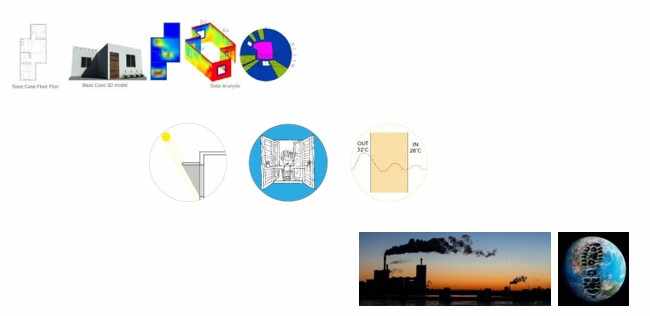
Much can be learned by studying well-designed buildings or spaces that were created with environmental design considerations integrated into the architectural design process. So, the first step in this case study module is to identify a building or a space that you are interested in. The second step is for you to examine the building/space-related environmental design issues through field work and on-site monitoring and use physical and computer modelling tools to explore the environmental performance of the chosen building.
2. Objective
This module aims to examine the architectural spatial experience and environmental design issues of a selected case study.
This study should be backed up by a review of existing literature and performance analysis using fieldwork, on-site monitoring, physical models and/or computer-based environmental design tools. We are interested in the interaction between the spatial experience, light, air, heat and the built forms.
Firstly, you should have a holistic understanding of the light, heat, sound and air aspects of environmental design in your chosen case study, then you can focus on the investigation of only one aspect or several aspects of the environmental design issues. In this module, both quantitative and qualitative analyses are equally important. You should use observation, questionnaires, surveys and interviews to conduct the qualitative analysis and to correlate this with the data obtained from the quantitative studies.
3. Deciding on your Case Study
You have the freedom to choose your case study and the aspects you would like to explore. The case study can be a building or a particular indoor or outdoor space that has drawn your interest. This can include any building typology or urban space. However, it must have enough scope for the development of your work.
You can choose a building/place that you may not have access to. In this case, your case study will be mostly theoretical and developed through the use of virtual and physical models. You may also choose a building/place that you can visit and experience for yourself. In this case, you will be able to do on-site spot measurement and longer-term monitoring and survey the users. Both focuses are fine as long as you meet the module learning outcomes.
Below you will find a list of some examples of previous projects that have been accepted and presented in international peer-reviewed conferences. This is a great accolade for the quality of the work resulting from this module because it means that the international scientific society in the field of environmental design believes these works are original, add knowledge and have been developed with rigour – and are therefore worthy of publication. Please go through these papers available on Moodle and/or online and use the topics and methods to inspire your selection.
4. Sample of Published Past Case Study Projects
LANG, N., MENDOZA, E., OH, J., RODRIGUES, L., TUBELO, R., KIAMBA, K. 2024. “Evaluation of Retrofit Design Impacts on Carbon Emissions: A Case Study of Cullinan Studio’s Foundry Project”. In: Widera, B., Rudnicka-Bogusz, M., Onyszkiewicz, J., Woźniczka, A. eds. 2024. Proceedings of 37th PLEA Conference, Sustainable Architecture and Urban Design – PLEA 2024:
(Re)Thinking Resilience. 26-28 J 2024 ł , P ł U v y S
Technology. Pp. 1068-1073. Available from: https://plea2024.pl/wpcontent/uploads/2024/06/PLEA2024_BOOK%20OF%20PROCEEDINGS.pdf [Last accessed
03.12.2025].
ALAM, S., RODRIGUES, L., KIAMBA, L. 2023. “Exploring Vernacular Courtyard Strategies to Improve Thermal Performance of Modern Housing in Dhaka”. In: Riffat, S. ed. 2023. Sustainable Energy Technologies: Proceedings of the 20th International Conference on Sustainable Energy Technologies – SET 2023, 15th – 17th August 2023, Nottingham, UK. University of Nottingham: Buildings, Energy & Environment Research Group. Volume 1, Pp. 232-238. Available from: https://nottingham-repository.worktribe.com/output/31448392 [Last accessed 02.12.2025].
POMCHAPALLI, P., RODRIGUES, L., KIAMBA, L., 2022. “An Evaluation of the Thermal Performance and Energy Efficiency of Atria in Hotel Buildings in the UK: A Case Study of the Orchard Hotel, Nottingham” In: Riffat, S. ed. 2022. Sustainable Energy Technologies: Proceedings of the 19th International Conference on Sustainable Energy Technologies – SET 2022: 16-18 August 2022, Istanbul, Turkiye. Volume 3, Pp. 242-251. Available from: https://nottinghamrepository.worktribe.com/output/17381378[Last accessed 02.12.2025].
POMCHAPALLI, P., RODRIGUES, L., KIAMBA, L., 2022. “The Thermal Performance of a Prefabricated Modular Hotel Room: A Case Study of Hotel Jakarta, Amsterdam” In: Riffat, S. ed. 2022. Sustainable Energy Technologies: Proceedings of the 19th International Conference on Sustainable Energy Technologies – SET 2022: 16-18 August 2022, Istanbul, Turkiye. Volume 3, Pp. 252-261. Available from: https://nottingham-repository.worktribe.com/output/17381378 [Last accessed 02.12.2025].
K NKIP I, L S , KI M , L , I U S, L , 2020 “An Investigation of The Luminous Environment in Nottingham H.O.U.S.E”. In Álvarez, J. R. & Gonçalves, J.C.S. ed. 2020. Planning Post Carbon Cities. Proceedings of the 35th PLEA Conference on Passive and Low Energy Architecture (PLEA 2020). A Coruña: University of A Coruña. Spain, 1-3 September 2020. Available from: https://doi.org/10.17979/spudc.9788497497947 [Last accessed 02.12.2025].
LECARO, M., LAU, B., RODRIGUES, L. JARMAN, D. 2017. “The application of vernacular Australian environmental design principles in Glenn Murcutt’s architecture”. Future Cities and Environment. 3(1), 3. Available from: http://dx.doi.org/10.1186/s40984-017-0026-6 [last accessed 31.01.2020]
M KIN , , I U S, L , 2017 “Building Resilience for Future Climate: An Investigation of Fabric Optimisation to Improve Thermal Comfort in Residential Buildings in
Lagos, Nigeria” In: Brotas, L., Roaf, S. & Nicol, F. ed., 2017. Design to Thrive: Proceedings of the 33rd Passive and Low Energy Architecture Conference (PLEA 2017). Volume I, Pp. 2-9; 2nd – 5th July, Edinburgh, United Kingdom. Available from: https://plea2017.net/#programmes-container [Last accessed 02.12.2025].
ADEMAKINWA, A., LAU, B., RODRIGUES, L., 2017. “The Environmental Performance of the Engineering Science and Learning Centre UK: An investigation of thermal and light benefits from an atrium covered by ETFE cushions” In: Brotas, L., Roaf, S. & Nicol, F. ed., 2017. Design to Thrive: Proceedings of the 33rd Passive and Low Energy Architecture Conference (PLEA 2017). Volume I, Pp. 583-590; 2nd – 5th July, Edinburgh, United Kingdom. Available from: https://plea2017.net/#programmes-container [Last accessed 02.12.2025].
MADHI GNANAPRAKASAM, A. S., RODRIGUES, L., FOX, C., 2017. “Addressing Thermal and Daylight Performance in Energy Efficient Retrofits: The Mundella Centre”. In: Brotas, L., Roaf, S. & Nicol, F. ed., 2017. Design to Thrive: Proceedings of the 33rd Passive and Low Energy Architecture Conference (PLEA 2017). Volume II, Pp. 3048-3055; 2nd – 5th July, Edinburgh, United Kingdom. Available from: https://plea2017.net/#programmes-container [Last accessed 02.12.2025].
SIN , P , I U S, L , 2017 “Comfort and Energy Efficiency in a Victorian House in the Past, Present and Future”. In: Brotas, L., Roaf, S. & Nicol, F. ed., 2017. Design to Thrive:
Proceedings of the 33rd Passive and Low Energy Architecture Conference (PLEA 2017). Volume II, Pp. 3118-3125; 2nd – 5th July, Edinburgh, United Kingdom. Available from: https://plea2017.net/#programmes-container [Last accessed 02.12.2025].
ABDULLA, Z., RODRIGUES, L., 2016. “The Effect of Shading, Infiltration and Ventilation Levels on Overheating and Heating Demands in UK Residential Buildings – Case Study: Trent Basin
Regeneration”. In: LaRoche, P. & Schiler, M. ed. 2016. Cities, Buildings, People: Towards Regenerative Environments, Proceedings of the 32nd International Conference on Passive and Low Energy Architecture (PLEA 2016). Volume II, Pp 1371-1377; July 11-13, Los Angeles, California, USA. Available from: https://nottingham-repository.worktribe.com/OutputFile/1238559 [Last accessed 02.12.2025].
KAWAI, A., LAU, B., 2016. “The Daylighting Performance of Azuma House and 4 x 4 House Design by Tadao Ando”. In: LaRoche, P. & Schiler, M. ed. 2016. Cities, Buildings, People: Towards Regenerative Environments, Proceedings of the 32nd International Conference on Passive and Low Energy Architecture (PLEA 2016). Volume II, Pp. 955-961; July 11-13, Los Angeles, California, USA.
Available from:
https://drive.google.com/file/d/0B5FiDvU_cPUeYWYtYjQ5N3dvWjQ/view?resourcekey=0JKS8yQoT8_DcItUKt2gZAQ [Last accessed 02.12.2025].
EYAS, M., LAU, B., 2016. “Spatial and Environmental delight in Louis I Kahn’s residential buildings – the study of luminous environment and thermal comfort in Fisher’s House by Louis I Kahn”. In: LaRoche, P. & Schiler, M. ed. 2016. Cities, Buildings, People: Towards Regenerative Environments, Proceedings of the 32nd International Conference on Passive and Low Energy Architecture (PLEA 2016). Volume II, Pp. 1275-1280; July 11-13, Los Angeles, California,
USA. Available from:
https://drive.google.com/file/d/0B5FiDvU_cPUeYWYtYjQ5N3dvWjQ/view?resourcekey=0JKS8yQoT8_DcItUKt2gZAQ [Last accessed 02.12.2025].
XU LI, L , L U, , 2016 “Architectural and Environmental Delight in Traditional and Contemporary Courtyard House in Beijing”. In: LaRoche, P. & Schiler, M. ed. 2016. Cities, Buildings, People: Towards Regenerative Environments, Proceedings of the 32nd International Conference on Passive and Low Energy Architecture (PLEA 2016). Volume II, Pp. 1256-1262; July
11-13, Los Angeles, California, USA. Available from:
https://drive.google.com/file/d/0B5FiDvU_cPUeYWYtYjQ5N3dvWjQ/view?resourcekey=0JKS8yQoT8_DcItUKt2gZAQ [Last accessed 02.12.2025].
MOSTOFA, S., LAU, B., 2016. “Louis I. Kahn’s Climate Responsive Strategies in the Tropics: A Case Study on National Parliament Building, 1448 Bangladesh”. In: LaRoche, P. & Schiler, M. ed. 2016. Cities, Buildings, People: Towards Regenerative Environments, Proceedings of the
32nd International Conference on Passive and Low Energy Architecture (PLEA 2016). Volume III, Pp. 1448-1453; July 11-13, Los Angeles, California, USA. Available from:
https://drive.google.com/file/d/0B5FiDvU_cPUeb3FJVU54bDFWbDA/view?resourcekey=0MBj8ck2guaUPaP18iLtQ2g[Last accessed 02.12.2025].
- N Y , , I U S, L , 2015 “Solar Access Design in the Tropics: The Thermal Strategy of Tomas Sanabria” In: 31st International Conference on Passive and Low-Energy Architecture PLEA 2015: Architecture in (R)Evolution. Bologna, Italy, 9-11 September 2015.
Available from:
https://drive.google.com/file/d/0B5FiDvU_cPUeZ1hZT2hBNV9pazA/view?resourcekey=041Zk5xgwjUv99kv9Z4ZpGQ [Last accessed 02.12.2025].
- Z , , I U S, L , 2015 “Solar Access in High Density Urban Developments: A Representative Case in Matlock” In: 31st International Conference on Passive and Low-Energy Architecture PLEA 2015: Architecture in (R)Evolution. Bologna, Italy, 9-11 September 2015.
Available from:
https://www.academia.edu/38938847/SOLAR_ACCESS_IN_HIGH_DENSITY_URBAN_DEVELOP MENTS_A_REPRESENTATIVE_CASE_IN_MATLOCK [Last accessed 02.12.2025].
L , M , I U S, L , L U, , 2015 “The Application of Vernacular Australian Environmental Design Principles on Contemporary Housing “. In: RODRIGUES, L. ed. 2015.
Sustainable energy for a resilient future: Proceedings of the 14th International Conference on Sustainable Energy Technologies – SET 2015, 25th to 27th of August 2015, Nottingham, UK. The University of Nottingham Eprints. Volume III, Pp. 570-579. Available from: http://eprints.nottingham.ac.uk/id/eprint/34706 [Last accessed 02.12.2025].
RODRIGUES, L., KACEL, S. and GILLOTT, M., 2013. “Energy Efficient Retrofit of a Protected Building of Historical Significance” In: PLEA 2013 – 29th Conference on Passive and Low Energy Architecture: Sustainable Architecture for a Renewable Future. Munich, Germany 10-12 September 2013. Available from: http://mediatum.ub.tum.de/doc/1169285/1169285.pdf [Last accessed 02.12.2025].
DEOGUN, I., RODRIGUES, L. and GUZMAN, G., 2013. “Learning from the Swahili Architecture in Mombasa, Kenya” In: PLEA 2013 – 29th Conference on Passive and Low Energy Architecture: Sustainable Architecture for a Renewable Future. Munich, Germany 10-12 September 2013. Available from: http://mediatum.ub.tum.de/doc/1169323/1169323.pdf [Last accessed 02.12.2025].
GHABRA, N., RODRIGUES, L. and LAU, B., 2013. “Architecture Excellence and Environmental Performance: The Case of Broadcasting Tower, Leeds, UK” In: PLEA 2013 – 29th Conference on Passive and Low Energy Architecture: Sustainable Architecture for a Renewable Future. Munich, Germany 10-12 September 2013. Available from: http://mediatum.ub.tum.de/doc/1169244/1169244.pdf [Last accessed 02.12.2025].
DAO, M. and RODRIGUES, L., 2013. “Visual and Thermal Performance in Façade Design” In: PLEA 2013 – 29th Conference on Passive and Low Energy Architecture: Sustainable Architecture for a Renewable Future. Munich, Germany 10-12 September 2013. Available from: http://mediatum.ub.tum.de/doc/1169402/1169402.pdf [Last accessed 02.12.2025].
SS , , I U S, L L U, , 2011 “Designing Carbon Neutral Schools: The Victor Miller Building, A Critical Review” In: BODART. M. & EVRARD, A. eds., Architecture & Sustainable Development: Proceedings of the 27th Conference on Passive and Low Energy Architecture – PLEA 2011. Volume 2. Presses Universitaires de Louvain. 471-476. Available from: https://www.researchgate.net/publication/236542655_Designing_carbon_neutral_schools_The_Vic tor_Miller_Building_a_critical_review [Last accessed 02.12.2025].
KAIMAKLIOTIS, D., LAU, B., 2011. “The Poetics of Contemplative Light in the Church Of NotreDame-du-Haut Designed By Le Corbusier”. In: BODART. M. & EVRARD, A. eds., Architecture & Sustainable Development: Proceedings of the 27th Conference on Passive and Low Energy Architecture – PLEA 2011. Louvain-la-Neuve, Belgium (July 2011). Available from: https://www.scribd.com/document/483738904/The-poetics-of-copntemplative-light-in-the-Churchof-Notre-Dame-du-Haut-designed-by-Le-Corbusier [Last accessed 02.12.2025].
SAKARELLOU-TOUSI, N., LAU, B., 2009. “The Vernacular Dwellings of Mount Pelion in Greece:
A migratory living pattern”. 26th Conference on Passive and Low Energy Architecture PLEA 2009,
Quebec City, Canada, 22-24 June 2009. Available from: https://www.researchgate.net/profile/Benson-Lau-
2/publication/237769125_The_Vernacular_Dwellings_of_Mount_Pelion_in_Greece_A_migratory_li ving_pattern/links/5971f18c0f7e9bfdca6b7326/The-Vernacular-Dwellings-of-Mount-Pelion-inGreece-A-migratory-living-pattern.pdf [Last accessed 02.12.2025].
5. Stages of the Development of your Case Study
These stages have been developed to help you organise your time and develop an interesting report. The stages detailed below should be followed throughout the semester as described in the timetable.
Stage 1 – Feasibility
Identifying potential case studies
- Location, typology, use
- Designers, design intentions
- Why is this a relevant building to study?
- Can you get plans, sections and other relevant information?
- Are there any previous works undertaken using this building? – What will be your main focus of study?
Stage 2 – Characterisation
Defining the focus of the study and gathering necessary information
- Collect all the information needed to get your case study started (plans, sections, architectural intention, environmental design strategies, accessibility, etc)
- Define your main focus and a research question
- Define your methodology to answer your research question (qualitative and quantitative)
- Plan your study (this can be done through a Gantt chart)
- Read relevant literature and write a literature review relating to visual and thermal comfort in the building typology you are studying, and including any other similar studies as precedents
- Undertake a microclimate analysis around the focus of the study
Stage 3 – Development
Developing the methodology, collecting data
- Use rules-of-thumb and calculations for an initial building assessment
- Develop and undertake surveys, questionnaires and/or interviews whenever applicable
- Undertake on-site measurements whenever applicable
- Build and test a physical model whenever applicable
- Build and test computer models
Stage 4 – Interpretation
Analysing data and describing the results
- Analyse the data collected in Stage 3 in view of the characterisation done in Stage 2
- Analyse the results of each research method utilised around the focus of the study
Stage 5 – Discussion
Summarising findings using a critical thinking approach
- Relate qualitative and quantitative results
- Summarise all findings in a meaningful and insightful manner
- Identify gaps that may need to be readdressed
Stage 6 – Re-evaluation
Addressing the implications of the findings
- Look back at the building and critically discuss the implications of your study
- Propose/apply changes and/or recommend design strategies
Stage 7 – Narrative
Writing the case study in a highly readable manner
- Integrate and summarise key information around the focus of the study in a way that an outside reader is able to fully understand the case study just by reading the narrative and looking at key supporting figures
6. Learning Outcomes
1. Knowledge and understanding
A1) of the key environmental and sustainable design principles and their practical applications; A2) of the opportunities and benefits that arise from exploring sustainable design principles in architecture and urban design;
A3) of the key research and building/space performance prediction and evaluation methods; A4) of the human factors affecting the perception and performance of the built environment.
2. Intellectual skills
B1) enable informed judgments about the appropriate environmental and sustainable strategies to deliver high performing spaces;
B2) demonstrate an understanding of environmental and sustainable design principles and practice in relation to specific design problems;
B3) demonstrate the ability to conduct meaningful building performance analysis, critically interrogate simulation results and draw insightful conclusions.
3. Professional practical skills
C1) identify and pursue interesting and relevant research questions;
C2) evaluate and select appropriate tools and techniques to assess the performance of spaces and their design.
C3) write meaningful and insightful articles/reports, convening technical knowledge.
7. Assessment
The coursework will be developed week by week. There are 2 stages of assessment in this module:
1. Case Study Review
(worth 20% of your final mark) You will be required to summarise your case study development, including all items listed in Stages 2 to 6, in a maximum of 12 minutes. Focus only on key information that tells the story. A colleague will be timing your presentation, so please practice in advance. Please upload your presentation to the M ’ M y 3 y v .
2. Case Study Research Paper
(worth 80% of your final mark): This is a 4000-word A4 format paper summarising the results from your work. Please use the template provided in Moodle for your submission and follow its instructions carefully, as this will help you build a quality paper. In addition to the core 4000-word paper, you may include supplementary appendices where you can add any extra information that is not essential for the research paper, but still interesting – for example, tested alternative environmental design solutions, the actual data collected, a survey if you developed one, etc. Please upload your work to M ’ M y 3 pm on the day of the submission.
8. Marking Criteria
The marking of each coursework will be based on the following criteria, aligned with the module learning outcomes:
1. Knowledge and understanding
A1) Objectives: relevance, originality and clarity of research question and aims of the enquiry in relation to human comfort and space performance.
A2) Methods: appropriateness of chosen research methods and standards, appropriate use of qualitative and quantitative methods.
2. Intellectual skills
B1) Rigour: rigorosity of methodology and processes, quality of critical analysis or results, evidence-based development.
B2) Outcome: meaningfulness of findings, critical reflection addressing the implications of the findings, and contribution to knowledge.
3. Professional practical skills
C1) Structure: appropriate and clear structure of work to answer the enquiry, including narrative and work execution.
C2) Presentation: quality and clarity of presentation, and clarity and fluency of the language.
9. Reading List
Please check Moodle for a number of downloadable resources and a list of further reading material, and please ensure you ’ y .
10. Timetable [last revised on 23/01/26]
| Week | Date | Activity | Tutors* |
| 1 | 26.01.26
|
Introduction: Case Studies in the Built Environment
Lecture: Introduction to the Module by Prof Lucelia Rodrigues and Dr Mohataz Hossain Workshop: Case study ideas Lecture: Design aid by simulation tools: Nottingham H.O.U.S.E by Prof Lucelia Rodrigues Homework: Wollaton Hall (read the extract in Moodle and visit) and Stage 1 |
LR/MH
LR/MH LR |
| 2 | 02.02.26
|
Micro-climate and Environmental Performance
Lecture: Environmental Performance of Garment Factories: A Case Study in Bangladesh by Dr Mohataz Hossain Workshop: Micro-climate Analysis – Brief Introduction to Autodesk FORMA Tutorials: Case Study ideas and Stage 1 Homework: Stage 2 and start Stage 3 |
MH
MH MH
|
| 3 | 09.02.26
|
Post-Occupancy Evaluation (POE) and Case Study Development
Lecture: Buildings Under the Microscope by Prof Mark Gillott Tutorials: Stage 2 (including queries on POE) Homework: Stages 3 and 4 |
MG MG/MH
|
| 4 | 16.02.26
|
Daylight and Solar Access
Lecture: Daylight and Solar Access: A Case Study in Mombasa by Dr Lorna Kiamba Workshop: Daylight and solar access rules-of-thumb and Sefaira Homework: Conclude stages 2-4 and start stage 5 |
LK LK |
| 5 | 23.02.26
|
Interim Review: Stages 2-4
You must bring the evidence of your case study developments. This includes a draft presentation of the Case study Development with conclusions drawn for stages 24. Verbal feedback will be provided. Homework: Stage 5 |
LR/MH |
| 6 | 02.03.26
|
Designing for Comfort
Lecture: Optimising the Building Envelope for Energy Efficiency and Thermal Comfort by Dr Renata Tubelo Tutorials: Building Physics, Passivhaus and PHPP Homework: Stage 5 and 6 |
RT
RT |
| 7 | 09.03.26
|
Climate Resilience
Lecture: The Development of a Case Study: the BASF house by Prof Lucelia Rodrigues Tutorials: Stages 5 and 6 Homework: Stages 6 and 7 |
LR
LR/MH |
| 8 | 16.03.26
|
Building Performance Assessment
Lecture: Using Integrated Environmental Solutions (IES) to assess building performance by Dr Mohataz Hossain Workshop: IES Refresher Homework: Stages 6 and 7 |
MH
MH |
| 20.03.26 | Coursework 1 Submission (20%)
P y M ’ M y 3 y before the review (please note this means Friday 3pm). |
||
| 9 | 23.03.26 | Final Review: Stages 2-6
You must submit your Coursework 1 on time as instructed above. Your tutors will review your ‘Coursework 1’ that you have submitted on Moodle and will provide you with verbal feedback during this review session. You will also receive your marks and written feedback after this session. Homework: Stage 7 |
LR/MH |
| Easter Break [Friday 27 March to Sunday 26 April] | |||
| 10 | 27.04.26 | Case Study Development, Q&A Session
Tutorials: All stages Homework: Conclude stage 7 |
LR/MH |
| 04.05.26 | Early May Bank Holiday | ||
| 11 | 11.05.26 | Stage 7 Tutorial – Peer Mentoring
For the last class, you will swap your draft coursework and help each other improve. For this exercise, you need a draft of your coursework ready for revision. This may contain gaps, but you must use the template provided in Moodle. This is a compulsory exercise for all classes. |
LR/MH |
| 12 | 18.05.26
|
Coursework 2 Submission (80%)
Your final paper should be uploaded to Moodle by 3 pm. |
|
| 18.06.26
30.06.26 |
End-of-year show and exhibition (including prize-giving)
External examination board |
||
*LK: Lorna Kiamba, LR: Lucelia Rodrigues, MG: Mark Gillott, MH: Mohataz Hossain, RT: Renata Tubelo
Order Custom ABEE4011 Case Study Research Paper
The post ABEE4011 Case Study Project Assessment Brief 2026 | University of Nottingham appeared first on Students Assignment Help UK.