AVM345 Airline Operations and Planning End-of-Course Assessment 2026 | SUSS
AVM345 End-of-Course Assessment
Instruction To Students
- This End-of-Course Assessment paper comprises 7 pages (including the cover page).
- You are to include the following particulars in your submission: Course Code, Title of the ECA, SUSS PI No., Your Name, and Submission Date.
- Late submission will be subjected to the marks deduction scheme. Please refer to the Student Handbook for details.
Important Note
ECA Submission Deadline: Saturday, 04 April 2026 12:00 pm
ECA Submission Guidelines
Please follow the submission instructions stated below:
A – What Must Be Submitted
You are required to submit the following item for marking and grading:
- A Report
Please verify your submissions after you have submitted the above item.
B – Submission Deadline
- The Report is to be submitted by 12 noon on the submission deadline.
- You are allowed multiple submissions till the cut-off date.
- Late submission will be subjected to mark-deduction scheme by the University. Please refer to Section 5.2 Para 2.4 of the Student Handbook.
C – How the Report Should Be Submitted
- The Report: submit online to Canvas via TurnItIn (for plagiarism detection)
- Avoid using a public WiFi connection for submitting large video files. If you are using public wireless (WiFi) connection (e.g. SG Wireless at public areas), you might encounter a break in the connection when sending large files.
D – Additional guidelines on file formatting are given as follows
| Report | • Please ensure that your Microsoft Word document is generated by Microsoft Word 2016 or higher.
• The report must be saved in .docx format. |
E – Please be Aware of the Following
Submission in hardcopy or any other means not given in the above guidelines will not be accepted. You do not need to submit any other forms or cover sheets (e.g. form ET3) with your ECA.
You are reminded that electronic transmission is not immediate. The network traffic may be particularly heavy on the date of submission deadline and connections to the system cannot be guaranteed. Hence, you are advised to submit your work early. Canvas will allow you to submit your work late but your work will be subjected to the mark-deduction scheme. You should therefore not jeopardise your course result by submitting your ECA at the last minute.
It is your responsibility to check and ensure that your files are successfully submitted to Canvas.
F – Plagiarism and Collusion
Plagiarism and collusion are forms of cheating and are not acceptable in any form in a student’s work, including this ECA. Plagiarism and collusion are taking work done by others or work done together with others respectively and passing it off as your own. You can avoid plagiarism by giving appropriate references when you use other people’s ideas, words or pictures (including diagrams). Refer to the APA Manual if you need reminding about quoting and referencing. You can avoid collusion by ensuring that your submission is based on your own individual effort.
The electronic submission of your ECA will be screened by plagiarism detection software. For more information about plagiarism and collusion, you should refer to the Student Handbook (Section 5.2.1.3). You are reminded that SUSS takes a tough stance against plagiarism or collusion. Serious cases will normally result in the student being referred to SUSS’s Student Disciplinary Group. For other cases, significant mark penalties or expulsion from the course will be imposed.
G – Use of Generative AI Tools (Allowed)
The use of generative AI tools is allowed for this assignment.
- You are expected to provide proper attribution if you use generative AI tools while completing the assignment, including appropriate and discipline-specific citation, a table detailing the name of the AI tool used, the approach to using the tool (e.g. what prompts were used), the full output provided by the tool, and which part of the output was adapted for the assignment;
- To take note of section 3, paragraph 3.2 and section 5.2, paragraph 2A.1 (Viva Voce) of the Student Handbook;
- The University has the right to exercise the viva voce option to determine the authorship of a student’s submission should there be reasonable grounds to suspect that the submission may not be fully the student’s own work.
- For more details on academic integrity and guidance on responsible use of generative AI tools in assignments, please refer to the TLC website for more details;
- The University will continue to review the use of generative AI tools based on feedback and in light of developments in AI and related technologies.
Section A (50 marks)
Answer all questions in this section.
Question 1
Scoot is the low-cost airline of Singapore Airlines (SIA) Group and was launched in
June 2012 as a long-haul low-cost carrier. It started operations with two Boeing 777200 aircraft and later introduced six Boeing 777-200ERs before switching its widebody fleet to the Boeing 787-8 and Boeing 787-9. In July 2017, Scoot merged with Tigerair under the Scoot brand, bringing in Tigerair’s Airbus fleet and created a combined network operating on Boeing 787 Dreamliners and Airbus A320. Ahead of SilkAir’s integration into Singapore Airlines, the Group also shifted a number of SilkAir regional routes to Scoot in phases from April 2019 into the second half of 2020 to better match capacity and costs to thinner markets. Most recently, Scoot began adding Embraer E190-E2 regional jets to right-size capacity and improve frequency options on smaller regional routes, further increasing fleet diversity. Scoot’s active fleet in early January 2026 as 58 aircraft across six types: 13 Boeing 787-8, 11 Boeing 787-9, 12 Airbus A321neo, 7 Airbus A320neo, 6 Airbus A320, and 9 Embraer E190-E2.
Question 1a
Using Scoot’s fleet evolution as context, appraise the advantages and disadvantages of maintaining a diverse, multi-aircraft-type fleet for a low-cost airline. In your answer, provide at least three (3) advantages and three (3) disadvantages, and explain each point with reference to how it could affect network planning, cost structure, and operational reliability.
(12 marks)
Question 1b
Determine a clear judgement on Scoot’s introduction of the Embraer E190-E2 fleet: Is it overall a positive or negative development for Scoot’s network and business model, and why? Your conclusion must be consistent with the points you raised and show balanced evaluation.
(8 marks)
Question 2
You are advising Scoot on commercial strategy for the following two (2) hypothetical markets:
Market A
- Distance: ~3.5 hours from Singapore
- Demand: Price-sensitive leisure and VFR, strong seasonality (peaks during school holidays)
- Competition: 1 competing LCC operates daily; 1 full-service carrier operates 4x weekly with connections beyond its hub
- Airport: Secondary airport with incentives, but limited late-night slots
Market B
- Distance: ~7 hours from Singapore
- Demand: Mixed leisure + VFR, steadier year-round
- Competition: 1 full-service carrier operates 2x daily with strong loyalty programme; another LCC operates 5x weekly
- Airport: Primary airport, higher fees, strong peak-hour demand
For each market, propose a practical commercial plan aligned to a low-cost carrier (LCC) model. Your answer must address all of the following:
1. Target segments and value proposition (Market A and Market B)
Analyse the primary customer segments and write a clear value proposition for Scoot in each market.
(8 marks)
2. Capacity and schedule strategy (Market A and Market B)
Recommend a schedule approach for each market (for example: frequency choice, time-of-day positioning, peak/off-peak adjustments, seasonal capacity moves). Explain the trade-offs (load factor, utilisation, connectivity potential, operational risk).
(8 marks)
3. Pricing and ancillary revenue strategy (Market A and Market B)
Propose at least three (3) tactics per market covering base fare positioning and ancillaries (for example: fare families, bundles, baggage/seat upsell, promo timing, targeted offers, and prioritising local versus connecting traffic).
(10 marks)
4. KPIs and monitoring
Recommend two (2) KPIs per market (4 KPIs total) that Scoot should track weekly, and explain why each KPI matters.
(4 marks)
(Total 30 marks)
Section B(50 marks)
Answer all questions in this section.
Generative AI tools are permitted for background research and information gathering only; all critical analysis, interpretation, and final conclusions must be your original work. Failure to properly disclose the use of AI, or submitting AI-generated analysis as your own, will be potentially considered a breach of academic integrity.
Question 3
The aviation industry is a complex ecosystem where safety, regulatory compliance, and operational efficiency are deeply intertwined. To maintain the highest levels of safety, the industry relies on a robust framework of international conventions, ICAO Standards and Recommended Practices (SARPs), and national regulations. Failure to manage operational risks, whether related to fuel planning, mass and balance, crew fatigue, or the transport of dangerous goods, can lead to catastrophic outcomes.
Question 3a
Select an airline that has experienced a significant operational incident, accident, or major safety breach (e.g., fuel exhaustion, an emergency involving weight and balance errors, a dangerous goods incident, or a fatigue-related event). Examine the events leading up to the occurrence, focusing on the operational decisions and environmental factors involved. In your answer, you must cite various resources including academic articles, industry reports, and media to support your analysis.
(15 marks)
Question 3b
Verify five (5) annexes’ and/or conventions’ components which were significant relating to the accident. You may also use CAAS guidelines and Air Navigation Regulations to support your answer.
(10 marks)
Question 3c
Select a Safety Management System (SMS) framework or a Hazard Identification and Risk Assessment (HIRA) model to apply to your chosen case study. Explain the principles of the model (such as the four components of SMS or the Probability-Impact Matrix) and form appropriate links to the failures or mitigations observed in the case. You may also consider incorporating Crew Resource Management (CRM) principles if human factors were a primary concern.
(15 marks)
Question 4
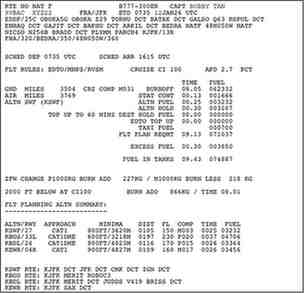
Based on the excerpt of the Operational Flight Plan, identify and interpret the following:
a. Details and considerations of the route for this particular flight.
(4 marks)
b. Details of the fuel requirements and its purpose.
( 4 marks)
c. Considerations relating to the usage of alternate aerodromes.
(2 marks)
(10 marks)
—– END OF ECA PAPER —–
The post AVM345 Airline Operations and Planning End-of-Course Assessment 2026 | SUSS appeared first on Singapore Assignment Help.